

UPDATE – The 23rd – 27th March 2026 is AI Awareness week.
Our members are increasingly managed and monitored by AI systems that:
- Intensify work through impossible algorithmic targets and constant productivity tracking
- Monitor constantly through sentiment analysis, AI dashcams, GPS tracking, and speech analytics
- Make decisions about performance, scheduling, and opportunities without transparency or human oversight
- Collect vast amounts of personal data without workers knowing what’s held or how it’s used
- Create stress and anxiety through relentless surveillance and pressure
We’ve set aside the 23rd to the 27th of March as a week to document the impact these systems have on our members, with a specific focus on work intensification.
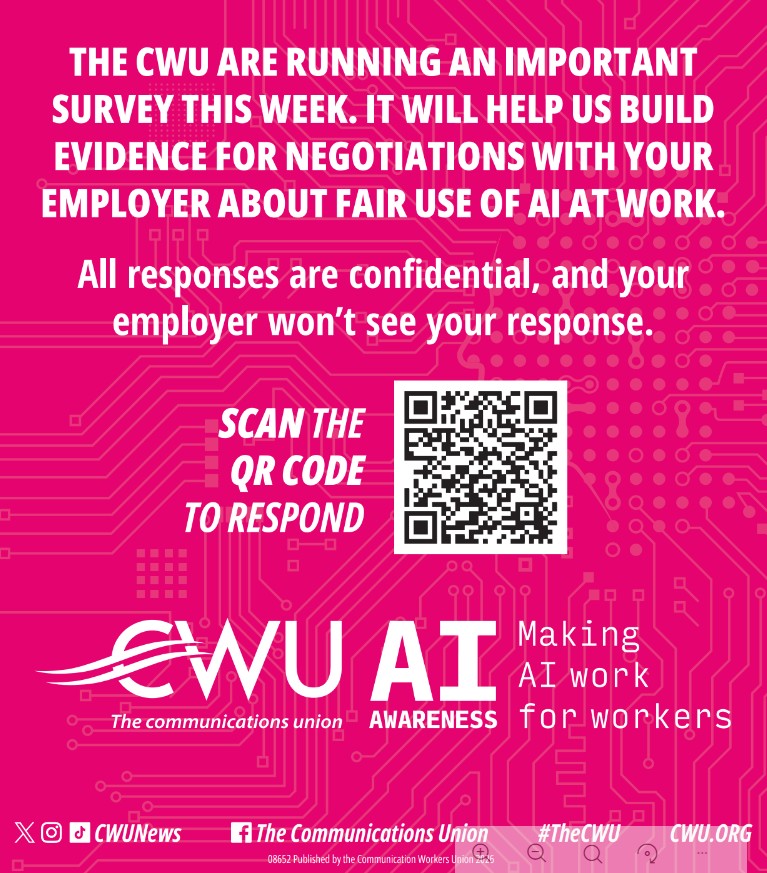
The CWU are asking members to complete a simple 5-10 minute anonymous and confidential online survey, which documents how AI makes them work harder. The survey will go live Monday 23 March.
This survey can be accessed by scanning the QR code or clicking here.
Members can share experiences using #WisetoAI
Artificial Intelligence (AI) and machine learning are being rolled out in telecoms and financial service industries – from contact centres and field operations, to telecoms engineers and desk-based roles. While these new systems might promise efficiency and cost savings, most benefits will be directed to employers and shareholders.
CWU is actively campaigning to make sure there is:
- Worker Voice, in the roll-out of AI in workplaces – at all levels of technology decision making, design and deployment.
A poll will be sent to all members via email, the week commencing 9th June. We are also producing the questions on a postcard, which will include a QR code. As a Branch we encourage members to take part in this, using the QR code, if they haven’t responded to the email.
A campaign webpage has also been set up at: https://www.cwu.org/ai-awareness - Workers have a fair share of the benefit of AI that lead to a better work life balance – through wages, new skills, working hours, and training.
- Safeguards from bias and discrimination. No AI system should be introduced without worker input, safeguards and clear rules.
- The CWU has delivered two online bitesize learning sessions exploring what AI actually is and how it is affecting the workplace. These can be viewed here.
AI is here already – Let’s Make it Work for Workers
THE UPSIDE – IF WORKERS ARE INVOLVED
More Time For Real Work
AI can handle repetitive tasks, letting you focus on more meaningful work.
Smarter Scheduling
AI can improve job planning and scheduling times and reduce stress, if done right.
Reduce Barriers To Knowledge or Skills
AI can help workers gain skills by making training material accessible and flexible and recognising existing experience.
Spotting Hazards and Faults
AI tools can take on tasks that are risky or time consuming for people, like: detecting equipment failures and checking safety guidelines are being followed correctly.
THE RISKS – IF WORKERS ARE LEFT OUT
Job Displacement
AI may replace jobs in customer service and network operations – resulting in many redundancies
Deskilling
A system can tell you to say or do something that you wouldn’t instinctively do. This removes your autonomy and professionalism, all to please the system.
Workload Pressure
AI can increase expectations and create an always-on work culture
Surveillance
Monitoring calls, movement and performance can be invasive and without proper safeguards can impose unreasonable targets and result in unsafe working conditions.
Fairness and Bias
AI is based on large data sets. That data doesn’t disappear and therefore if the computer learns some untruths about a set of people those decisions may reinforce unfair treatment or discrimination.
Privacy Issues
Portable and wearable devices, tracking location and cameras, can result in invasions of privacy and home life and contribute to the always-on culture.
Lack of Transparency
AI is being used to make important decisions about you, without your consent.
What are our goals?
To reach a collective agreement that covers:
- Transparency
- Mandatory Algorithmic Impact Assessments
- Job Security and Skills
- Redeployment and Skills Enhancement
- Data Rights, Ethical Use and Surveillance Limits
- Redress, Human Control, Accountability and Non-Discrimination
AI at Work : A New Health & Safety Challenge
Read the UK Dept of Education Report on ‘The impact of AI on UK jobs and training’ is – here
The clearer we can see where we’re heading, and the better we coordinate, the more likely we are to create a future where humans remain relevant – not as competitors to AI, but as their beneficiaries and stewards. As it stands, we’re racing to build our own replacements.
©The Guardian