
Stress Awareness Month is an annual event observed every April since 1992, dedicated to increasing public awareness about the causes, effects, and management of stress.
It serves as a gateway to open conversations about stress, signpost people to the right support and help us all to prioritise our mental health.
It is promoted by numerous organisations and the NHS.
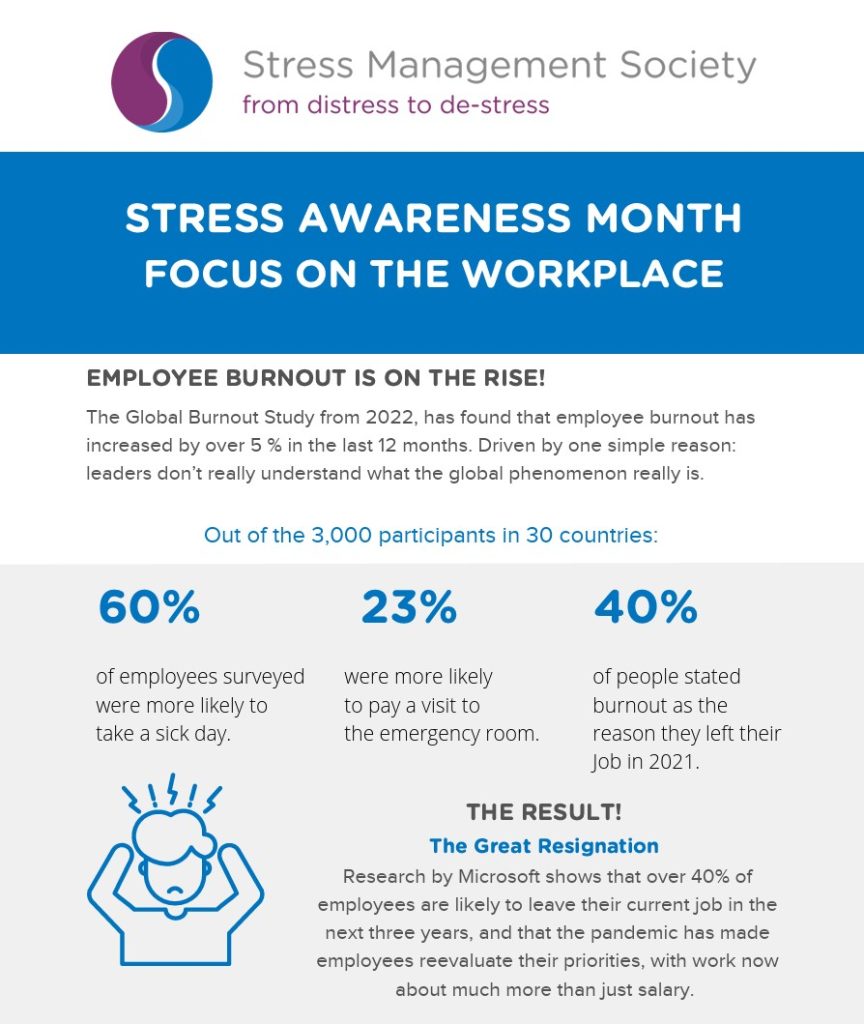
What is work-related Stress?
HSE defines stress as “a harmful reaction that people have to undue pressures and demands placed on them at work.” Stress can affect both mental and physical health and impact performance at work. Everyone experiences stress differently, and factors such as skills, experience, age, or disability can all influence how stress affects someone.
Psychosocial risks like stress, workload pressure and poor workplace cultures are increasingly recognised as a major workplace risk. The latest HSE statistics for 2024/25 (published in November 2025) showed that 964,000 workers were suffering from work-related stress, depression, or anxiety (new or long-standing) in 2024/25. This represents a significant increase on the 2024 figure of 776,000.
409,000 workers report suffering from a new case of work-related stress, depression, or anxiety in 2024/25, again a significant increase on the previous year’s figure of 300,000.
What’s new.
The 2026 #BeTheChange theme is about encouraging others to take action to support individuals who may be struggling to manage stress.
Stress Awareness Month 2026 – The Stress Management Society
Mental Health UK have created some especially useful downloadable resources for 2026. See link below.
There are several ‘How does it really feel on the inside’ guides, which provide facts about common mental health conditions, as well as practical self-help tips on stress and anxiety. Plus, there are six conversational guides and advice on how to speak to your doctor.
Mental Health UK – Downloadable resources
The HSE are also circulating their free guidance and tools throughout April –
Understand the impact of work-related stress
Free HSE – Working Minds learning module
The HSE Working Minds learning module is free and can be signed up for via the link above, it will help colleagues understand the HSE Management Standards. Whereby employers have a duty to actively manage six key areas of work design which are:
Demands – Workload, work patterns, and the work environment.
Control – The degree of control workers have over their work.
Support – The support workers receive from managers and colleagues.
Relationships – Promoting positive relationships at work.
Role – Understanding of job role and responsibilities.
Change – Managing and communicating change effectively.
In terms of the six key workplace stressors detailed above, the below ‘Key Considerations’ are shared for wider understanding of what any undertaken Stress Risk Assessment should aim to achieve.
Demands
| How any supported employee should feel: |
| You can cope with the demands of your job. You are provided with achievable demands in relation to the hours you work. Your skills and abilities are matched to the demands of your job. Concerns about your work environment are addressed. |
Control
| How any supported employee should feel: |
| Consulted over the way their work is organised and undertaken, e.g. through regular meetings, one-to-ones, performance reviews. Regular opportunities for discussion and input at the start of projects or new pieces of work. Encouraged to use their skills and initiative to do their work.Consulted over things affecting their work. Encouraged to develop new skills and undertake new and challenging pieces of work. |
Support
| How any supported employee should feel: |
| They receive information and support from other employees and their managers. The organisation has systems in place to enable and encourage managers to support their employees and for employees to support one another. They know what support is available and how to access it. They know how to access the resources they need.They receive regular and constructive feedback. |
Relationships
| How any supported employee should feel: |
| Not subjected to unacceptable behaviours such as bullying or harassment at work. The organisation promotes positive behaviours at work. The organisation has agreed policies and procedures to prevent or resolve unacceptable behaviour. The organisation has systems in place to enable and encourage managers to deal with unacceptable behaviour. The organisation has systems in place to enable and encourage employees to report unacceptable behaviour. |
Role
| How any supported employee should feel: |
| They understand their role and responsibilities. The organisation provides information to enable them to understand their role and all their responsibilities. The requirements the organisation places on them are clear. They can raise concerns about any uncertainties or conflicts they have in their role and responsibilities through the systems that the organisation has in place. |
Change
| How any supported employee should feel: |
| The organisation engages with them frequently when undergoing change. They are provided with timely information, enabling them to understand the reasons for proposed changes. They are consulted on changes and provided with opportunities for them to influence proposals. They are aware of the probable impact of any changes to their job and, if necessary, they are given training to support any changes in their job. |
If you have any questions or need any further information relating to this topic, please contact Jamie McGovern (Health & Safety Policy Assistant, Central Services) on jmcgovern@cwu.org.
Or contact one of Branch officers – Contact details can be found Here