
A government timetable for this process which sets out when the provisions of the Act will be introduced has been produced. This includes some additional detail in relation to the Certification Officer, political funds, and the simplification of industrial action ballot papers and notices to the employer.
Published 3 February 2026 – Plan to Make Work Pay and Employment Rights Act: timeline update – GOV.UK
As the timetable shows, many of the new trade union rights will take effect from 18th February 2026, including:
- Repealing many parts of the restrictive Trade Union Act 2016
- Removal of the 12-week limit on industrial action dismissal protection
- The simplification of industrial action and ballot notices
- Ending the requirement for unions to appoint a picket supervisor
- Removal of the 10-year ballot requirement for trade union political funds
- New members automatically ‘opted in’ to political fund contributions.
Several further trade union rights are due to be implemented between April and October 2026, including:
- Measures to simplify the trade union recognition process
- Establishment of the Fair Work Agency to enforce employment standards.
- Electronic and workplace balloting for statutory ballots
- New rules on rights for trade unions to access workplaces
- A new duty on employers to inform workers of their right to join a trade union
- Measures governing unfair practices in the trade union recognition process
- New rights and protections for trade union representatives
- Extending protections against detriments for taking industrial action.
Together with trade union rights, there are also many individual rights being introduced under the Employment Rights Act, including for example:
- Rights to Statutory Sick Pay from day one of sickness and for workers earning below the current Lower Earnings Limit (April 2026)
- Requiring employers to take ‘all reasonable steps’ to prevent sexual harassment of their employees (October 2026)
- Enhanced dismissal protections for pregnant women and new mothers (2027)
- Bereavement leave including pregnancy loss (2027)
- Ending the exploitative use of zero hours contracts (2027)
This legislation represents a substantial improvement in UK employment rights and a major reversal of anti-trade union law that was introduced by successive Conservative governments. It has been hard won by unions after nearly a decade of campaigning and the CWU can be extremely proud of the role we have played in securing these important changes through our New Deal for Workers campaign.
The CWU will continue to campaign for the swift and effective implementation of the policies set out in this timetable. We will also continue to push for the measures that were part of our New Deal campaign, which are not included in the Act but which the government is considering as part of the Make Work Pay manifesto commitments. This includes taking further action on the gig economy, introducing further sectoral collective bargaining measures, protecting workers from surveillance at work and creating a single status of worker.
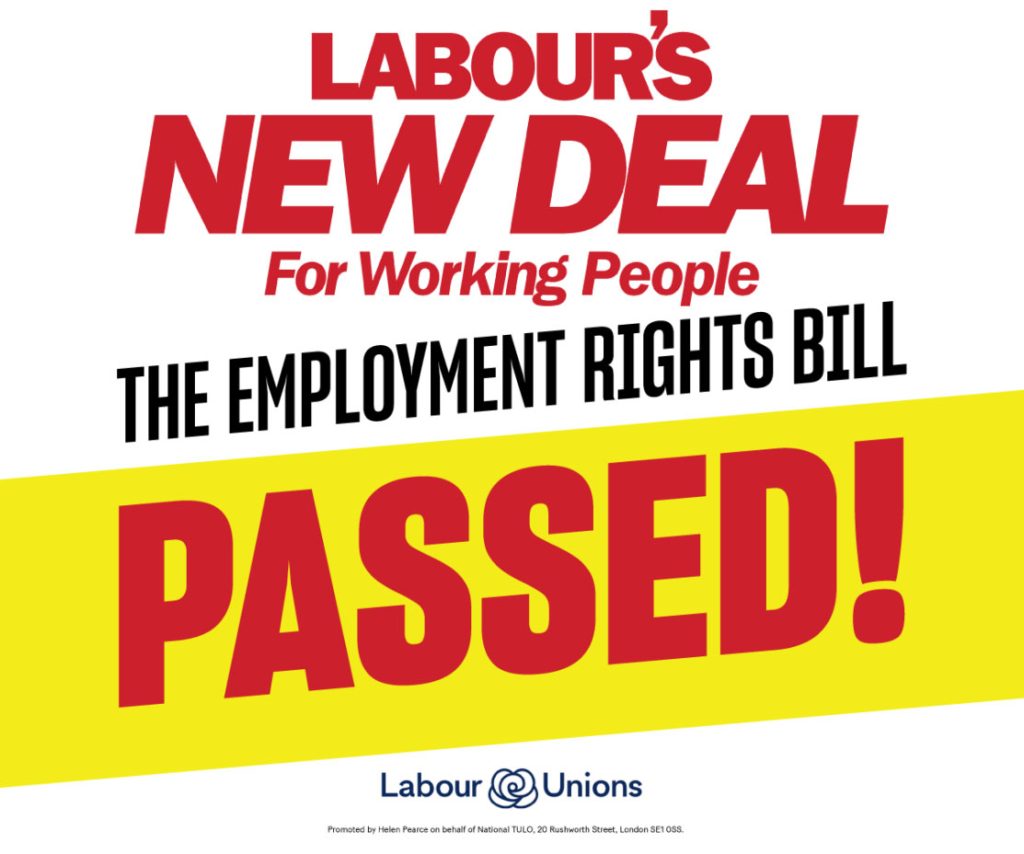
Labour’s landmark Employment Rights Bill has finally passed BOTH Houses of Parliament.
The TUC has today (Tuesday 16th December, 2025) hailed an “historic day” for working people as the government’s flagship workers’ rights Bill has finally broken its House of Lords deadlock after months of wrangling in parliament.
- Guaranteed hours contracts – the right for everyone to have a contract that reflects the hours they actually work, cracking down on exploitative zero-hours contracts.
- Repealing anti-union laws like the Tories’ draconian 2016 Trade Union Act.
- Protections against fire and rehire – new protections making it harder for bad employers to fire you if you don’t accept cuts in pay or conditions.
- Tougher enforcement of rights – a new watchdog to crack down on bad bosses and ensure all employers respect rights at work.
- More say at work – stronger rights for unions to campaign and negotiate to win better pay and conditions for workers.
The legislation will introduce long overdue changes like a ban on exploitative zero-hours contracts, day one sick pay and better protection from harassment – among a range of other measures. Conservative Peers – who have been blocking the legislation for weeks – have finally stepped aside. It will now quickly receive Royal Assent and become law.
This means that millions will benefit from day one sick pay for all from April 2026. If the Bill had been delayed beyond Christmas, the whole timetable would have been pushed back and workers would have missed out on the first tranche of rights coming into force in April.
Long overdue
The Employment Rights Bill will bring the UK closer to the European mainstream. The UK has been an outlier on workers’ rights with insecure work rife in every corner of the country. One in nine of the workforce are currently stuck in insecure work, and one million are on zero-hours contracts. The TUC says this huge upgrade in workers’ rights is not just good for workers, but good for the economy too – more money in the pockets of workers means more spending in our local shops and high streets.
Recent TUC analysis shows the wider benefits of the Bill are £10.4 billion. This is significantly more than the costs, which have previously been estimated at between £0.9bn and £5bn. The TUC says this is a giant leap forward for stronger workers’ rights. There will now be a phase of consultations and secondary legislation required to enact key rights – the TUC says it is vital these rights are delivered in full and as quickly as possible.
Commenting on the Employment Rights Bill passing the Lords, completing its parliamentary passage and paving the way for it to become law, TUC General Secretary Paul Nowak said: “This is an historic day and early Christmas present for working people across the country, and the trade unions who represent them.
“Banning exploitative zero-hours contracts, sick pay for all, expanding parental and bereavement leave, strengthening protections for pregnant women, whistleblowers and victims of sexual harassment, repealing Tory anti-union laws, ensuring union access to workplaces, establishing a social care fair pay agreement – these are just some of the watershed measures this Bill will now deliver. “Unions and workers have long campaigned for these vital rights. Together, we have broken a decades long economic status quo defined by insecurity, weak rights and poor pay.
Futher work required
However, the work does not stop here. The CWU, alongside other unions, will continue to campaign for the swift and effective implementation of the policies in the legislation. Many regulations and practical elements of the policies will be decided in secondary legislation and we will continue to lobby the government to ensure that they are implemented in the strongest way possible.
There are also other parts of the New Deal for Workers that are not contained within the Bill itself but the government will be reviewing as part of the Make Work Pay manifesto commitments. This includes taking further action on the gig economy, introducing further sectoral collective bargaining measures and creating a single status of worker. The CWU will be campaigning strongly for these policies and we will keep branches updated with the progress of these other initiatives as developments occur.
“Finally, working people will enjoy more security, better pay and dignity at work thanks to this Bill. “It’s now vital that workers start feeling the benefits of this legislation in their lives as soon as possible. That means the legislation must be implemented in full, and at speed – with watertight secondary legislation to ensure there are no loopholes for bad bosses to exploit.”